
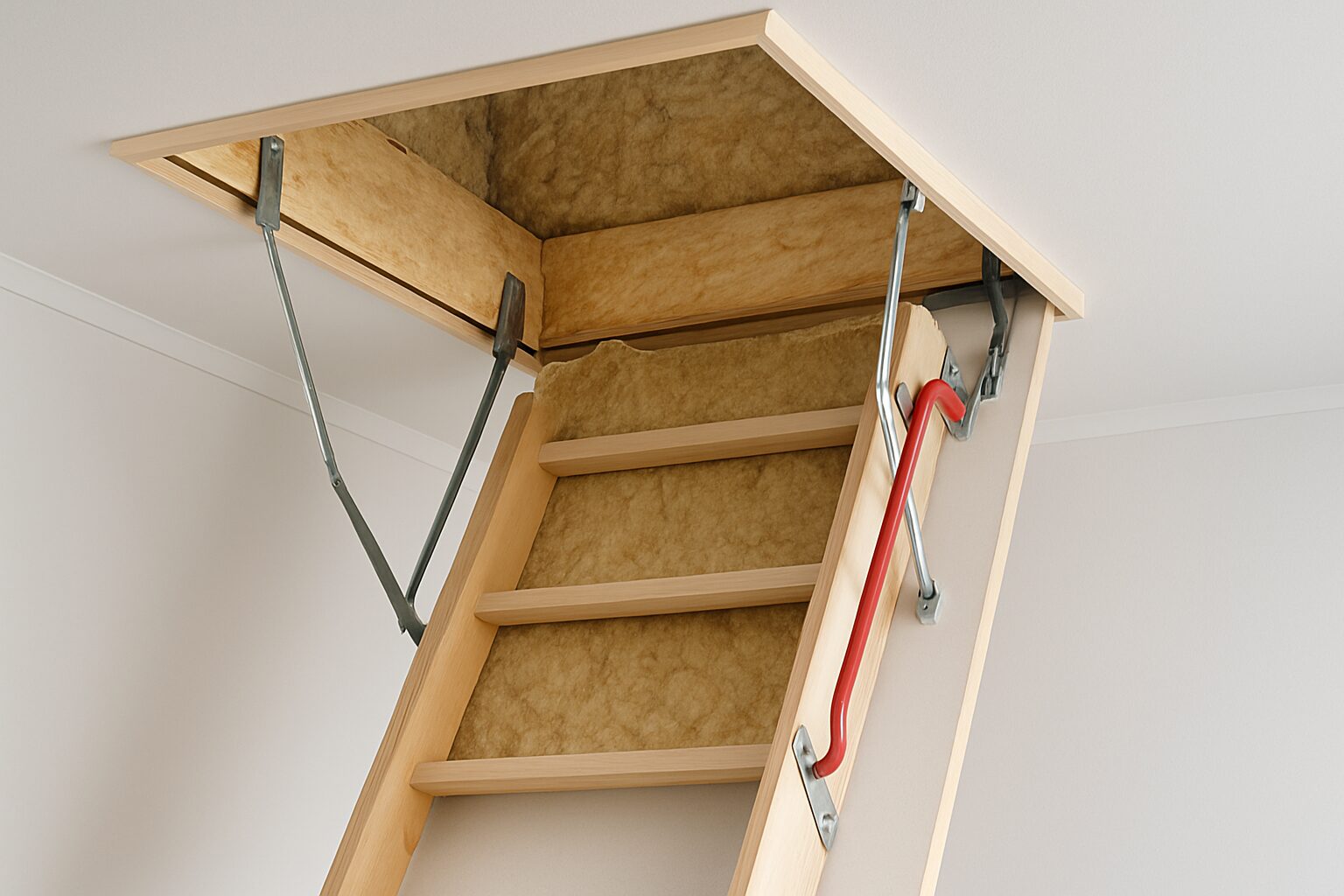

Heat loss through loft access points is a commonly overlooked contributor to high energy costs. A standard, uninsulated hatch can account for a disproportionate amount of thermal transfer—particularly in homes that otherwise have good ceiling insulation. An insulated loft ladder system addresses this directly. A thermally efficient loft ladder system integrates an insulated door panel, draught seals, and sometimes a thermally broken frame to close this gap.
Why Does Loft Access Affect Home Energy Efficiency?
Loft insulation is among the most cost-effective home energy improvements available. According to the Energy Saving Trust, a well-insulated loft can save a typical semi-detached household £150 or more annually on energy costs.
However, even 270 mm of quality loft insulation loses its effect at the hatch point if the access door is thin, poorly sealed, or made from uninsulated timber. The hatch becomes a thermal bridge—a direct path for heat to escape from the living space below.
What Makes a Loft Ladder System “Insulated”?
Not all ladders marketed with insulation deliver equal performance. Look for these specific features:
U-value of the hatch door:
A U-value measures how quickly heat passes through a material (W/m²K)
Standard uninsulated hatch doors can have U-values above 2.0 W/m²K
High-performance insulated hatches achieve values of 0.6 W/m²K or lower
The lower the U-value, the better the thermal resistance
Draught sealing:
Foam or rubber compression seals around the hatch perimeter prevent air infiltration
Quality seals maintain compression over repeated open/close cycles without flattening
Thermally broken frame:
A thermal break prevents the hatch frame from conducting cold from the loft space into the ceiling structure
Found in premium systems; not standard across all insulated models
How Do You Compare Insulation Performance Between Products?
Request the U-value rating directly from the manufacturer or retailer. This single figure is the most reliable basis for comparison. A product claiming to be “thermally efficient” without a declared U-value provides no verifiable basis for that claim.
Additionally, check:
Whether the insulation is integrated into the door panel or added separately
The thickness of the insulation layer (thicker generally means better performance)
Whether the seals are replaceable when worn
Does Insulation Affect the Weight of the Ladder?
Yes, but modestly. Insulated hatch panels add between 2 kg and 6 kg compared to uninsulated equivalents, depending on insulation thickness and construction. For most homeowners, this difference is negligible in practice—particularly in systems with gas-assisted springs that counterbalance the door weight during deployment.
If physical strength is a concern, look for systems with gas struts rated for the heavier door panel.
What Is the Return on Investment for an Insulated System?
The premium for an insulated loft ladder system over a standard model typically ranges from £80 to £200 at purchase. Set against annual energy savings from reduced heat loss through the hatch—which can range from £20 to £60 per year depending on home size and heating costs—the payback period is generally two to seven years.
Over the 15–20 year lifespan of a quality system, the cumulative savings comfortably exceed the initial cost premium. This calculation strengthens further as energy prices increase.
Which Homes Benefit Most from an Insulated System?
Insulated loft ladder systems deliver the greatest value in:
Homes where the loft is accessed frequently (more open/close cycles mean more air exchange if uninsulated)
Older properties with high heating costs and limited existing draught proofing
Properties in colder climates where the temperature differential between living space and loft is consistently large
Homes where loft insulation has recently been upgraded, as the hatch becomes a more pronounced weak point
For homes in mild climates with moderate heating costs, the standard insulated system still pays for itself—it simply takes longer.
An Upgrade Worth Making
Combining a high-quality loft ladder with an insulated hatch door and effective draught seals is a straightforward way to improve your home’s thermal efficiency. For the majority of homeowners, the financial and comfort benefits make it one of the more rewarding practical upgrades available.